Digital Competence of Educators

a picture of a team of educators using digital technologies

As our mission as educators change from "busy in front of the class" to "the class is often online", so our skills as educators need to change to cater to this digital reality.

The European framework for the Digital Competence of Educators (DigCompEdu) proposes 22 competencies that we as educators need in order to excel in the digital world.

DigCompEdu has six focus areas for the digital life of educators. Each focus area describes a number of competencies. View them all by clicking on each competence in the diagram at the bottom of this page.

Also, go to the DigCompEdu website and download the framework and do the self-assessment to see where you stand on each of the competences.

Focus area 1 is about our professional engagement as educators. How we communicate, collaborate, reflect, and continuously develop as professionals. This focus area could be applicable to other occupations as well.

Focus area 6 is about the digital competence of others - our learners; how they gather information, communicate, create, use and solve problems.
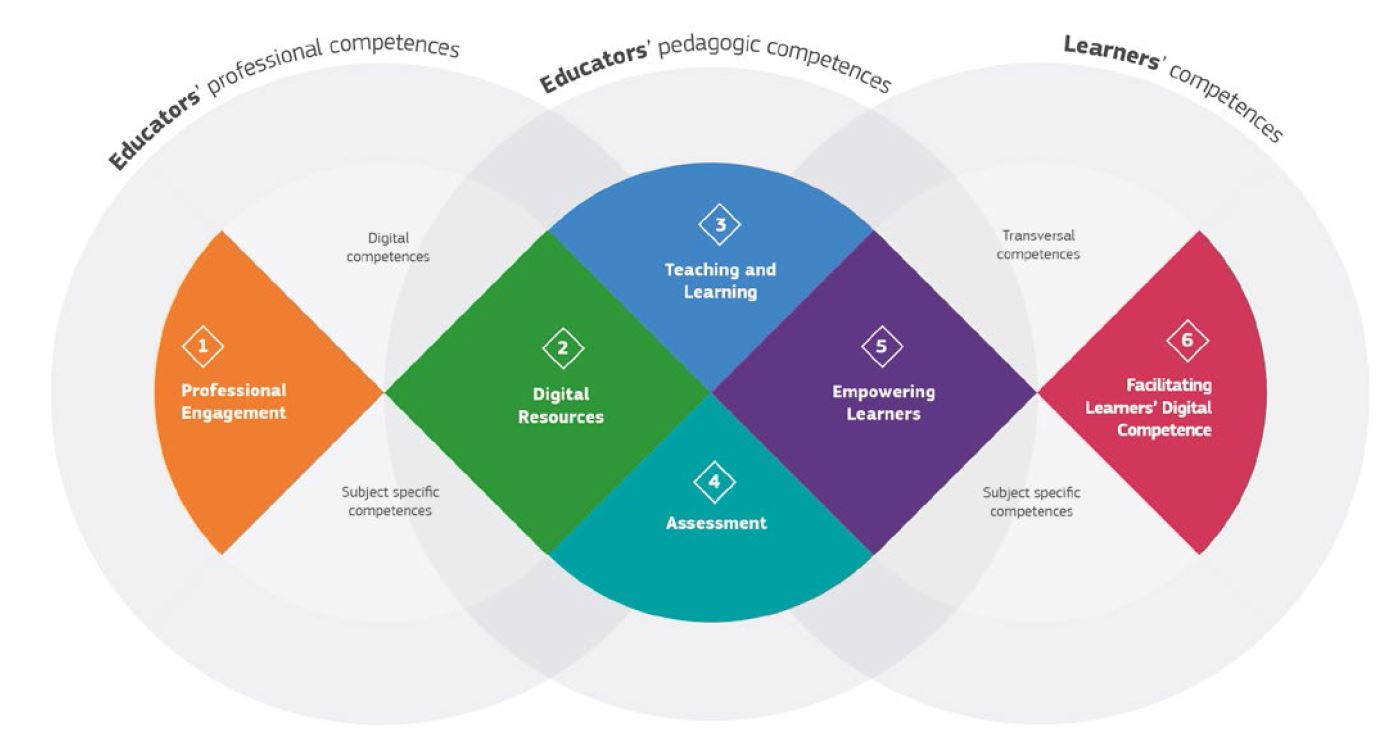
DigCompEdu framework Digital Competence of educators framework

Focus areas 1 and 6 complements the core of the framework: Areas 2-5, that deal with the essence of teaching and learning online. Go to each of the competences below to learn more about the competence; how it is covered in the course and what other free technologies there are out there to support our competence as educators.
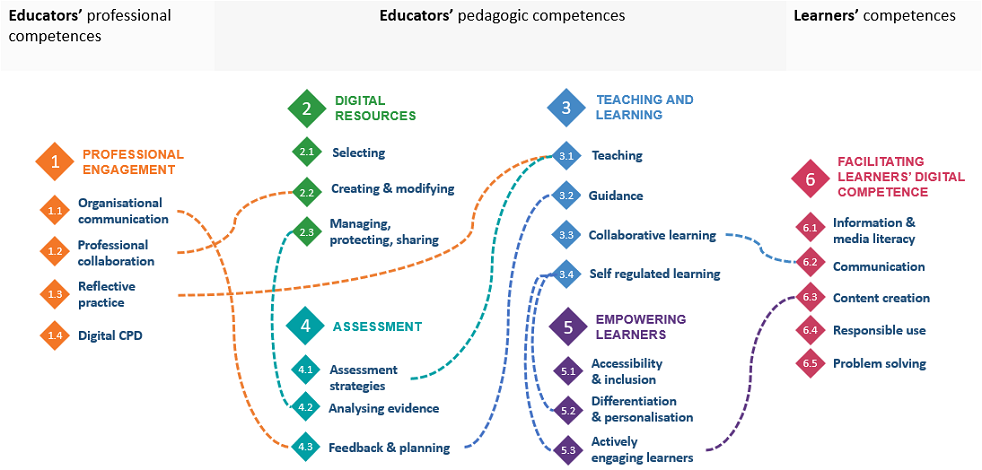
The whole framework

DigCompEdu framework Digital Competence of educators framework Professional Engagement Communication Collaboration Reflect CPD Digital resources Selecting Creating Managing Assessment Assessment Evidence Feedback Teaching and learning Teaching Guidance Collaboration Self-regulated Empowering learners Accessibility Differentiation Engaging Learners Facilitating Learners's Digital COmpetence Media Literacy Communication Content Creation Engaging Learners Engaging Learners

The progression model

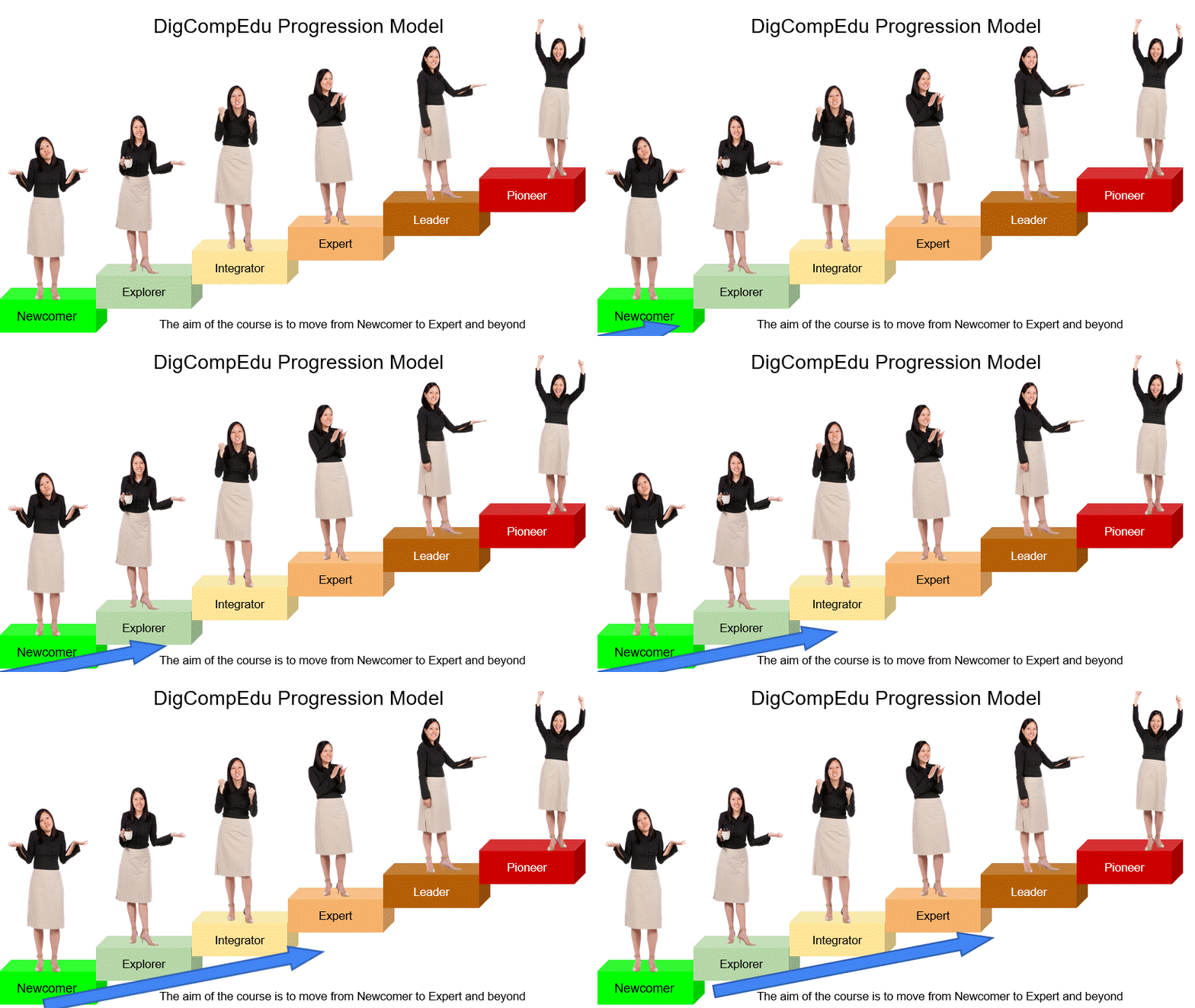
DigCompEdu competency progression model

The developers of the DigComEdu framework also propose a progression model that describes various proficiency levels in six competence stages. (If you take the self assessment at the DigCompEdu site, you will see at what level of proficiency you are in each of the competencies. The levels work as follows:

  • Newcomers, at level 1 are aware of the potential of digital educational technologies.
  • Explorers, at level 2 have already begun to use digital technologies in their educational projects, albeit not comprehensively.
  • Integrators at level 3, experiment with digital technologies in various situations and for various purposes. It is the ambition of the course described here to give participants plenty of opportunities to experiment.
  • Experts at level 4, are confident and creative users of digital technologies to enhance their educational projects. They have a wide repertoire of digital skills that they deploy depending on the situation at hand.
  • Leaders at Level 5, are able to give direction to the educational team with regards to the deployment of digital technologies because they reflect on what's possible and keep updated by interacting with their peers, sharing best practices.
  • Pioneers at Level 6, look beyond what’s possible here and now and what is being done here and now. They experiment and develop novel digital technologies and pedagogical practices that can employ technologies that they discover.
  • The Collaborative Laboratory

    The European Union's framework on the Digital Skills of Educators (DigCompEdu) answers the question "What digital skills do educators need to capitalize on the potential of digital technologies for enhancing and innovating education?" COVID added a second part to this question: "Now that we can't meet in class due to COVID-19, what skills do I need to use technology to not let my students down?"
    A Collaborative Laboratory has been set up for digital educators - at whatever proficiency level - to experiment by creating digital learning interventions. Everybody, from Newcomers to Pioneers, are welcome to join the Lab. Those lower down the proficiency scale to learn from those higher up. Look at the Prezi below to see how this program was assembled to cover all 22 competencies in the framework.Your arrows can help you navigate the Prezi... 

    The aim of the Lab is to help participants indentify with each of the proficiency statements described in the detailed section of the DigCompEdu framework up to the level of "Expert" by exploring hands-on tasks in a digital learning environment. The proficiency statements under "Leader" are also discussed, preparing participants at the Expert level for leadership roles in digital education.

  • The Lab has been set up as six Moodle courses.
  • Each course covers one of the areas of competence described in the framework.
  • Spread over the six courses, are 22 sections.
  • Each section covers one of the competences.
  • Each section starts with a description of the competence and the outcomes for that section.
  • A reflective survey follows, giving participants the opportunity to gain insights into their own level of competence.
  • Each section contains a reading or search activity to explore the subject matter further.
  • Most importantly, each lab participant gets access to a Moodle Course that can be edited and "played with" in a "sandbox". No previous Moodle skills are required, but there are plenty of resources out there for one to develop to at least Expert level.
  • A forum activity follows, giving participants the opportunity to share with others how they achieved the outcomes of the section.
  • All participants will have access to all other participants' "sandbox" courses, potentially leading to hundreds of courses one could learn from.
  • Please visit the lab by following the link in the menu. As of 20 September 2021, there is not much material in the lab yet, but please continue to watch this space.Click here to download the pdf file to see how to enter the lab.